Develop Strategic Leaders with Business Acumen Training in Lancaster, CA
Improve your team’s competency with Strategy for Managers focused training in the Lancaster area
Today's volatile, uncertain, complex and ambiguous (VUCA) - world of business presents demanding obstacles organizations and leaders must overcome to achieve organizational priorities. Business Acumen, an imperative competency, has been identified by leaders and talent development professionals as a key driver for addressing our VUCA world challenges. Historically, business acumen competencies were reserved for the CEO and in some cases, the C-Suite. However, recent years have proven that organizations that develop business acumen throughout the lower and mid-levels of the organization ensure an important, competitive advantage.
Who would benefit from the training?
Our customized Business Acumen & Strategic Thinking for Managers program focuses upon developing critical thinking and planning competency, strategic agility, financial and commercial acumen, and strategic management competencies via a customized, simulation-like experience. We believe our program is better than a cookie-cutter business simulation competition, as the projects are company-selected and relevant to your strategic priorities.
The program combines learning with real work projects to produce strategic solutions while developing your team’s business, financial, and commercial acumen via business strategy simulation. As the cohort works collaboratively, through real business problems, the program improves your managers and/or HiPos’ leadership, collaboration, and teamwork skills.
Some of our clients are looking for a program for their executive or business unit leadership team. If you are seeking a strategic planning retreat or strategic planning consulting firm, please see our strategic growth planning and strategic alignment program here.

Learning Objectives:
At the Organizational Level the Learning Objectives Include:
- Interaction and collaboration opportunities between executives, board members, and high-potentials
- Support succession planning strategy
- Align cross-functional teams with the mission, vision, and strategic plans.
- Actionable business projects provide strategic impact to the business
- Strategic HR Development
- Change management components aid in learning retention
- Increased competency
- Business competency development designed to impact the bottom-line
At the Cohort Level the Learning Objectives Include:
- Healthy competition and business-focused discourse
- Structured, required collaboration
- Participants learn to routinize the sharing of knowledge
- Participants are immersed in cross-functional problem solving
- Program structure provides learning opportunities with minimal risk to the business
- Alliances are built across the organization
- Strategic management best-practices are demonstrated, modeled, and routinely shared
- Participants form strong relationships and cross-functional knowledge, laying the path for ongoing collaboration
At the Individual Level the Learning Objectives Include:
- Develop insight into the correlation of business functions and operations
- Discover how the builder vs. protector mindsets impact business goals
- Strategic thinking skills
- Critical thinking and analytical skills
- Cross-functional knowledge across all areas of business’ operations
- Quality decision making
- Learn how to make and present a powerful, business case
- Cultivate the ability to be a master-asker (curious, questioning)
- Grow the ability to generate new ways of thinking and create solutions
- Learn to set effective team goals
- Grow financial acumen and budgeting knowledge
- Learn how to align organizational systems
- Grow the ability to be resourceful and innovative
- Develop financial analysis competency
- Understand and learn to practice strategic agility
- Negotiation skills
- Learning through doing
- Presentation skills development
- Influence skills
- Engage in systems thinking
- Engage in continuous improvement discussions
- Develop risk analysis/risk management skills
- Collaborate, negotiate and apply influence to establish plans and build a compelling business case
How does it work?
Business Acumen & Strategic Thinking Training Program
An effective Leadership Development program has three primary development categories:

For Phase 3: Leading in Business - the focus is on Business Acumen and Critical Thinking Skills.
While the final competency development objectives will be determined through the customization process of each business simulation training program and dependent upon the logistics and scope of the program, a comprehensive Business Acumen & Strategy Execution training focuses on the following business and strategic competencies:
Thinking & Analysis Skills:
- Analytical thinking
- Critical thinking
- Strategic thinking
- Data Analysis
- Holistic thinking
- Sound judgment
- Quality decision making
- Strategic Agility
Business Case Analysis:
- Ability to develop a compelling business case
- Problem-solving
- Global business savvy
- Dealing with ambiguity
- Strategic foresight
Accounting Skills:
- Finance for non-finance managers
- A passion for understanding the numbers
- Investment analysis
- Risk analysis & risk management
- Cost controls
Distinguishing Attributes:
- Executive presence
- Impact and Influence
- Perspective
- Presentation skills
- Negotiation skills
Looking for Public Seminars? We regret that we do not offer public seminars at this time. We do, however, have expert coaches who assist individuals in building their business acumen, and critical thinking skills. Please inquire.
Commercial Acumen and Critical Thinking for Managers Training Program
Our business-savvy and strategy for managers programs are most effective when participants have some management experience or after they have participated in foundational management training including interpersonal effectiveness and supervisory skills.
Our Business simulation competition - commercial acumen training program uses experiential learning opportunities, customized cohort work projects, collaboration between peers and mentors, business case development and capstone project presentations (a la Shark Tank presentations) to drive development and learning retention.
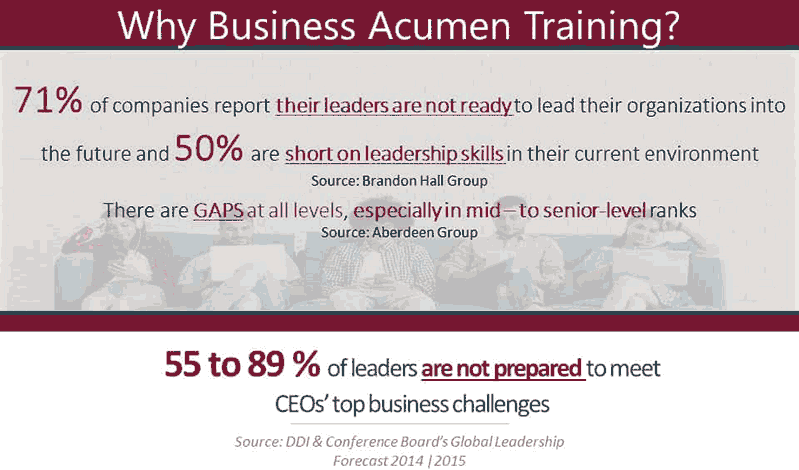
According to the SHRM Competency Model, business acumen is a critical capability in early managers all the way up to executives and competency varies despite business acumen being recognized as a necessary and important skill set for organizational success. Only 9.4% of early managers surveyed exhibited business acumen as a critical skill, and only 13.7% of mid-level managers demonstrate business sense. The percentage jumps to a measly 30.7% in senior-level managers. With executive leaders more involved with corporate decision making, the study reported a variable climb of a whopping 52% of executive leaders having a deeper sense of business acumen. Can a business or organization really expect to meet its strategic objectives when only one out of two executives and more than 70% of all other employees/managers don't understand all aspects of "the business of the business"?
It's our position that organizations cannot deny the impact that deficient business acumen has on its capacity to drive results.
What if you could align your team around a compelling strategic plan while building business acumen? Our data-driven strategic planning and strategic alignment program is based on the research of 600+ successful organizations.To build your strategic action plan and develop your team's business acumen skills simultaneously learn more here or call us today at 281-469-4244.
When / Important Logistics / Important facts for ensuring success
Our immersive, business strategy simulation and business simulation competition program leverages active-learning and real-work projects for an effective and results-oriented learning experience.
What are the logistics and delivery formats of the program?
Our programs are infinitely flexible. Each component is custom-designed around your organizational goals and budget. Programs are available in a variety of formats, including:
- Lunch and learns / Brown-bag learning opportunities
- 90-minute to half-day introductory sessions
- Comprehensive programs include full-day to multi-day active-learning training events
- Development programs (moving employees from skills knowledge to high-performance requires more change and accountability components) typically include a variety of learning events over a period of 12 to 24 months
- In-Person, on or off-site programs are typically the most effective
- Virtual, Instructor-Led training is also available
What are the components of the program?
We find that each company or non-profit organization will have very specific goals, budgets, and logistical requirements. Thus, we will not insist on a routine approach. However, we can share that our most effective business-simulation and acumen corporate development programs include:
- Stakeholder interviews to uncover the organization's goals
- Management consulting in support of well-considered and selected work projects (capstone projects)
- Coaching focused on business-case development related to the company's selected work projects
- Cohort groups collaborate on real work-projects and prepare business cases
- Presentations to the executive team or board of directors
- The program finale is a fun, engaging and competitive Shark Tank*-like presentation to the company's internal "investors";
- Workshops designed using active-learning and adult-learning principles
- Training agenda is focused on business, financial, and commercial acumen and is tailored for the industry and specific to your organization (i.e. private/public/non-profit/governmental entity)
- Optimal programs include a series of training events. For example, we recommend multi-day, and/or full-day training sessions and bi-monthly half-day sessions focused on the business acumen topics, plus group coaching, internal mentor support, practice presentation sessions, and one-on-one coaching, as needed.
- The group coaching is an essential component as each cohort group works with an experienced management consultant and executive coach to build their business cases with relevant feedback and constructive criticism in support of a dynamite presentation at the conclusion of the program.
- Internally facilitated project meetings to ensure accountability and cross-functional teamwork.
- Internal mentors serve as in-house experts and are provided well-defined rules of engagement that ensure fairness across all teams. Tip: Mentors cannot do the work!
- The final business case presentations culminate in a memorable and exciting conclusion and celebration.
Here's a sample time-line of events for our best-practice approach to the training:

What is business acumen? Simply put, business acumen is the ability to keenly understand the company's business strategy, the financial metrics, the external and internal factors influencing success and the ability to make quality decisions that align with the organization's best interest. Acute critical thinking and business insight, means leaders are equipped to discern and implement the necessary changes to achieve the goals of any business initiative. What we have learned is that an employee with a high level of business acumen can see the "big picture;" And, how the various factors from processes and technology to employee decisions and regulations are inseparably intertwined with a company's ability to accomplish its goals. Having a deep sense of business acumen allows employees to extract relevant and important data and to decide the appropriate course of action. This will naturally lead to improved results, more meaningful engagement within the organization and a stronger impulse to be a part of the company's success.
We have also learned that an employees' lack of business knowledge and business education show a direct correlation to organizational deficiencies. Companies fail when employees struggle to fully understand the company's vision and strategic priorities and how to apply critical thinking skills to their roles and responsibilities. This failure to think critically and creatively, or analyze the financial impact of a decision, results in poor execution, and an inability to implement business strategies efficiently. Ultimately, the inefficient implementation of business strategies further increases company misalignment and disarray.
This pattern can be changed with the development of critical and strategic thinking training, business and financial acumen development, and by developing your leader's ability to conduct proper business case analysis, both in-depth and in-the-moment. Business acumen is an essential skill for effective leadership teams to possess. With the fast pace of the changing business environment, it is more critical now than ever, for employees to develop a higher level of business acumen. When a manager is empowered with business acumen training, the manager's confidence grows along with their ability to analyze, think creatively, and make sound business decisions. It is this more elusive skill set of critical thinking that enables an organization to be more nimble and adapt to changes quickly.
Business acumen is not an innate skill. Luckily, it is something that can be developed. And, while some people may grasp the concept easier than others, depending on their personal experience, others may just take more time to master the skill. There are many approaches to developing business acumen, including coaching, mentoring, and on-the-job training, and the most effective method is experiential learning and business simulations. The latter two approaches, when thoughtfully designed, provide a customized learning experience that is also immediately applicable to the real-world needs of the company. Finally, business acumen training programs enable your managers to contribute to the company's strategic priorities, develop keen insights into how the company can avoid costly mistakes, and foster a culture more inclined to innovate than stagnate.
The Training Problem
We know that a one size fits all approach to training employees doesn't work. This is particularly true for developing Business Acumen. We will be the first to advocate for coaching and training, as the benefits are well-documented and undisputed. However, for strategic thinking, financial acumen, and some of the more advanced thinking and analytical skills, an effective program may also include:
- A change management and accountability approach
- Real work-projects provide immediate opportunities to apply the skills learned in the training sessions
- Real-world business simulation-style training
- Subject matter experts to inform and mentor participants
- A practical approach for learning about lateral and vertical thinking models
- Top-down support to foster real buy-in to the program
- Accountability check-points ensure engagement and prioritized attention
- Performance management protocols and oversight
- Quality assurance measures
- Coaching to foster integration and skill practice
- Peer-to-peer interaction to maximize learning retention and develop additional learning opportunities

For our business acumen development program we customize our proven curriculum for relevance and alignment with your business, industry and strategic priorities. Each program is designed to actively engage participants in rich learning experiences and adult-learning best practices.
NOTE: We do not have public training events. While our programs are available for groups only, we do have individual, one-on-one coaching programs for individuals seeking business acumen coaching. Please inquire.
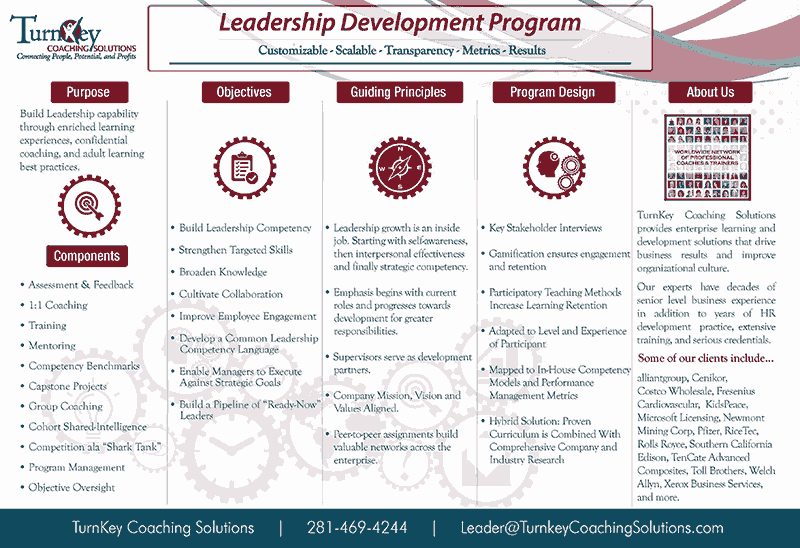
Please also see more information on our customized leadership development options:
Have questions? We have answers. Please also read our Strategic Thinking & Business Acumen Training Frequently Asked Questions here, for the details on our Business Acumen Training and Capstone Project development programs.
In today's fast-paced business changing environment, developing the business acumen capability of managers could mean the difference between success and failure. Business acumen is the safety net against errors and lost opportunities. When compared to other competencies, the ability to think strategically and evaluate an action against the strategic vision is the one skill that makes good people managers into great leaders. Unfortunately, business acumen training is often dismissed in favor of soft-skill development. Our position is that both are critical for successful company growth or organizational performance.
Make sure to also check out TurnKey's other services in the city: executive coaching programs, corporate leadership development, leadership team development, programs for emerging leaders and high potentials, Five Behaviors of a Cohesive Team programs, business retreats, and strategic planning consultations.
_____________
Disclaimer:
* Shark-Tank-Like: we are not associated in any way with the television show. We think it’s an awesome show and use the verbiage “shark-tank-like” because it accurately describes how our final capstone, business simulation competition, and business strategy simulation presentations are experienced by our clients. SHARK TANK is a trademark of Sony Pictures Television Inc. and is not associated in any way with this company or program.

Copyright ©2004-2026 TURNKEY COACHING & DEVELOPMENT SOLUTIONS, LLC
Disclaimer & Privacy Policy